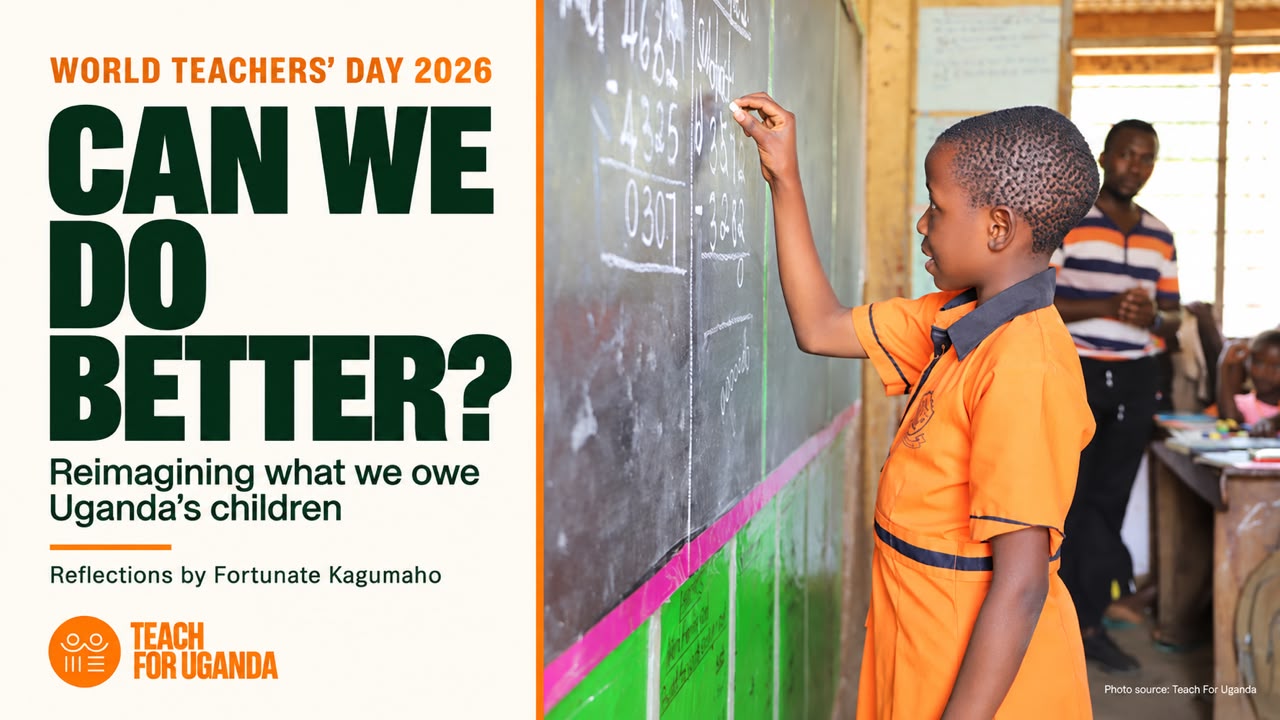
Reflections by Fortunate Kagumaho
World Teachers’ Day 2026 | 5 October 2026
Imagine this!
If a child you loved spent seven (7) years in school and still could not read a simple story, how long would you wait for something to change?
I ask because the language of education can make a deeply personal injustice sound administrative. We speak of learning gaps, resource constraints, and underserved communities. Behind those terms is a child getting older while the support they need remains out of reach.
On World Teachers’ Day, I want to ask whether we are as troubled by that child’s experience as we would be if it were happening in our own home.
Uwezo’s 2024 assessment, released in 2025, found that only 18.5% of ten-year-olds could read and comprehend a Primary Two-level English story. Only around three in ten could complete tasks involving all four basic arithmetic operations. These findings concern specific foundational skills. They should make us examine what years of schooling are actually delivering.
Enrolment matters. So does attendance. But what are we promising a family when we encourage them to keep a child in school, if we cannot also explain how that child will be helped to learn?
The consequences follow a child beyond the reading lesson. A learner who struggles to read may struggle to follow instructions in other subjects. As lessons become harder, the distance between what the class is being taught and what the child understands can widen. I worry about the moment a child begins to interpret that distance as evidence that they are incapable.
Who notices before that happens? Who is responsible for helping the child catch up, and what time, training, and materials do they have to do it?
The same Uwezo assessment reported 52 learners for every teacher in government-aided primary schools, compared with 21 in private schools. These averages cannot explain every classroom. They do, however, raise a serious question about how differently a teacher’s attention must be shared.
We should expect teachers to prepare, attend lessons and treat learners with care. We should also be able to say what support a teacher is entitled to expect in return. When we ask for individual attention, regular assessment and extra help for struggling learners, have we made those expectations workable?
This year’s theme, “Standing with teachers: 60 years of protecting the profession, advancing its status and shaping our futures,” should push us into that conversation.
What does standing with a teacher require of the people who approve budgets, deploy staff, procure books and decide which schools receive support?
I admire teachers who improvise when resources are scarce. I am uneasy when we turn that resourcefulness into a reason to leave the scarcity unresolved. A teacher’s commitment cannot create more hours in a school day. Celebrating endurance carries an obligation to examine what people are being asked to endure.
The questions become sharper in science, technology, engineering and mathematics. UNESCO’s 2025 account of STEM education in Uganda highlighted inadequate infrastructure, limited practical learning and shortages of qualified instructors, alongside barriers to girls’ participation. – I mean, we still have schools where their computer lab and physics lab are the old broken blackboard! Surely we can do better
When we tell a girl that she can become an engineer, what opportunities are we giving her to experiment, make mistakes, and understand how things work? An encouraging message needs a classroom that can support it. We should be asking whether the schools with the greatest need have the teachers and materials to make that encouragement credible.
I work with Teach For Uganda, so I cannot direct these questions only at government or at schools. They belong inside our organization too.
Our theory of change is to develop leaders through a two-year teaching fellowship in underserved schools. In the short term, Teacher Leaders work with schools to improve foundational learning and, through our STEM pilot, secondary STEM education. In the long term, alumni are expected to help address the wider barriers to educational opportunity.
To every Teacher Leader (Fellow) who keeps preparing lessons, noticing the learner who has fallen behind and trying again after a difficult day: your work matters!. So does your account of what is making it harder. You should be able to speak honestly about what is not working and receive a response that changes the conditions you face.
That is also a question for donors and partners, whose support makes this work possible. Will we fund the less visible work of coaching, school leadership, and follow-up over several years? Will we make room for evidence that an approach needs to change? The answers affect whether organizations can learn honestly while remaining accountable for results.
Government has a continuing responsibility for the public education system. Organizations such as ours should be clear about how their contribution strengthens it. A successful pilot should leave useful evidence, stronger teaching practice and a credible route to continuation. What happens when a grant ends must be part of the design from the beginning.
Doing better requires specific answers. Where learning is weakest, what support will reach the school, by when, and who will check whether it helped? When teachers identify an obstacle, who has the authority and resources to act? When an intervention falls short, will we change it?
I dream of a World Teachers’ Day that leaves teachers with more than the responsibility to keep trying. I want our appreciation to be visible in decisions that make good teaching possible and in evidence that children are learning.
The child struggling to read today will be a year older when we gather to celebrate teachers again.
What, exactly, will we have changed for that child?